
Key Takeaways:
How Chinese Oral Tips Help Your Child Ace the Exam
- These tips focus on building clear pronunciation, confident delivery, and structured responses, which are more effective than relying on memorised answers.
- Targeted reading aloud practice helps improve scores by strengthening pronunciation accuracy, pausing, and intonation through proven Chinese reading aloud techniques.
- Simple response frameworks such as PEEL guide students to organise their thoughts clearly, leading to stronger performance in the video conversation segment.
- Regular, low-pressure Chinese conversations at home help children gain fluency and confidence, making oral assessments less stressful and more manageable.
Introduction
For many Primary 6 students, the PSLE Chinese Oral examination can feel more demanding than a written paper. Students need to listen carefully, understand the question, organise their thoughts, and respond clearly in real time. Because there is little opportunity to pause or revise an answer once it has been spoken, nervousness can affect pronunciation, fluency, and the overall structure of a response.
Regular practice helps students become more comfortable with this process. By speaking aloud, responding to different question types, and receiving feedback, they can gradually improve their pronunciation, express ideas more smoothly, and organise their answers with greater clarity.
Starting Chinese oral practice in Primary 5 also gives students more time to build these skills steadily. This reduces the pressure to correct several weaknesses at once during Primary 6 and allows preparation to feel more manageable as the examination approaches.
This guide explains the PSLE Chinese Oral format, the common challenges students face, and practical ways to improve reading, conversation, fluency, and response organisation through consistent practice.
What the PSLE Chinese Oral Format Covers
Instead of jumping straight into general Chinese oral tips, understanding the PSLE Chinese Oral format ensures more effective preparation. The assessment consists of two key components, contributing a total of 50 marks.
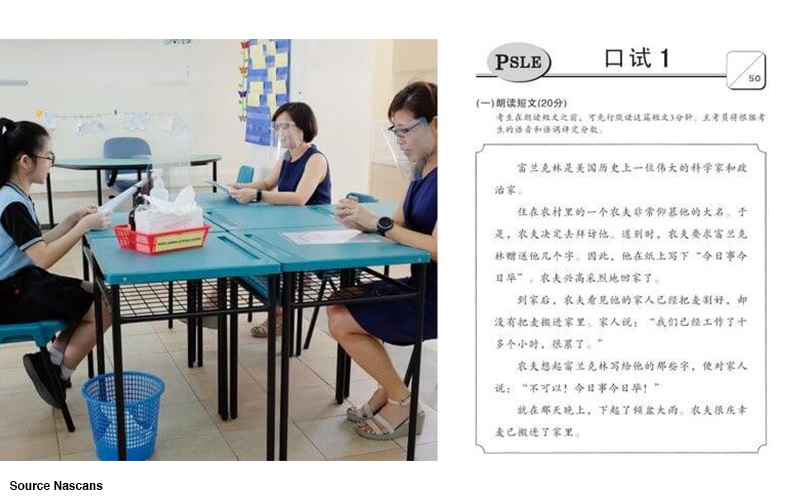
Reading Aloud (朗读短文) – 20 marks
This section evaluates how well students can read a short passage aloud. Examiners assess pronunciation accuracy, tone, fluency, pausing, and overall confidence. It is not about speed, but about clear, expressive reading that sounds natural.
Video Conversation (视频会话) – 30 marks
This component requires students to watch a short video and answer questions related to the situation shown. It tests interpretation, personal opinions, elaboration, and conversational ability. Strong responses show clear thinking, relevant ideas, and confident expression rather than memorised answers.
How to Perform Well With Practical Chinese Oral Tips
1. Understand What Examiners Expect
In order to answer how to score well for PSLE Chinese oral, the first and most important thing is to gauge examiners’ expectations. In general, examiners assess whether students can communicate meaningfully in Chinese. They look for students who can pronounce words clearly and accurately, read with proper rhythm and intonation, and speak fluently without excessive hesitation.
During the video conversation, students are expected to give relevant and structured responses, express personal thoughts confidently, and stay on topic while elaborating meaningfully. In other words, acing the oral exam is more about showing clarity, confidence, and coherence.
2. Strengthen Reading Aloud Skills
Reading aloud is often underestimated, yet it contributes a significant 20 marks. Students should pay close attention to pronunciation accuracy, especially avoiding common misreads of familiar words. These small errors can affect clarity even when the text is well understood. Pausing correctly at punctuation also helps the passage sound more natural and allows the examiner to follow the meaning clearly. In addition, avoid reading in a flat tone as it may sound weak and uncertain.
To score well in this section, students should apply effective Chinese reading aloud techniques through consistent, focused practice. Encourage your child to read aloud daily, paying attention to smooth pacing rather than rushing, as this helps build fluency and confidence. Recording and replaying their reading can also be beneficial, allowing students to hear their own pronunciation clearly and identify areas that need improvement.
3. Master Video Conversation Techniques
The video conversation section is where many students lose marks because they feel pressured to answer on the spot. Teaching a simple response structure can make a big difference.
One effective approach used in PSLE video conversation strategies is the PEEL structure. This structure serves as a thinking guide rather than a memorisation script.
- Point – Start by stating your core viewpoint clearly and directly
- Explain – Share points and reasons
- Example – Give specific examples that are related to the points
- Link – Tie back to the theme
Example of PEEL:
例子:我们应该如何培养学生友爱互助的行为?
Point: 我认为学校扮演重要的角色。
Explain:学校可以举办相关的活动
Example:比如组织学生参与社区服务、慈善义卖或分组合作学习
Link:学生能够在活动中体会到帮助别人的快乐,培养友爱互助的精神
Example question: How should we cultivate students’ values of friendship and mutual help?
Point: I believe that schools play an important role.
Explain: Schools can organise activities that encourage students to care for and support others.
Example: For example, students can be involved in community service projects, charity fundraising activities, or group-based collaborative learning tasks.
Link: Through these activities, students can experience the joy of helping others and gradually develop a strong sense of friendship and mutual support.
To complement this approach, you can practise structured responses with your child at home. When discussing a picture, short video, or daily situation, encourage your child to first give a clear answer, then describe what they see or have experienced. Gentle prompting with questions such as “为什么这样说?” (Why do you say so?) or “可以举一个例子吗?” (Can you give an example?) helps children practise elaborating without feeling pressured. Over time, this regular practice trains them to organise their thoughts quickly during the oral assessment.
4. Build Confidence Through Daily Speaking
Confidence in oral exams is built over time, not overnight. One of the most effective ways to support preparation is through regular, low-pressure Chinese conversations at home.
Simple daily exchanges make a difference. You can ask your child about their day, encourage them to talk about meals, or discuss a short video or activity in Chinese. These conversations help children become more comfortable thinking and responding in the language naturally. Starting early is also important. Consistent Chinese oral practice in Primary 5 builds a strong foundation, making the Primary 6 year less stressful and more focused on refinement rather than catching up.
Common Mistakes to Avoid:
When learning about angles, it’s common for children to make small errors as they build their understanding. These mistakes are often part of the learning process, but recognising them early can help prevent confusion later on.
- Rushing reading aloud
- Giving one-line answers without elaboration
- Memorising responses that don’t fit




 Choice Hua Sheng