
Key Takeaways:
Chinese Composition Tips: How Parents Should Guide Their Children
Parents should encourage children to:
- Identify the two PSLE composition formats to choose questions that suit their strengths.
- Stay closely aligned to the theme to avoid losing marks for writing off-topic.
- Use a clear story structure to keep ideas organised and focused.
- Strengthen expression by expanding emotions through actions, thoughts, and dialogue.
- Spend 3–5 minutes planning to improve clarity and flow in writing.
Introduction
Composition writing is often one of the most challenging parts of the PSLE Normal Chinese examination. Unlike vocabulary or comprehension questions, students are expected to develop a complete story, organise their ideas logically, and express thoughts and emotions clearly, all while staying relevant to the given topic.
Many students struggle to think of ideas, maintain a clear storyline, or describe characters’ feelings in enough detail. Others may have suitable ideas but find it difficult to express them naturally in Chinese, resulting in compositions that feel repetitive or lack depth.
The encouraging news is that these are skills that can be developed over time. With regular practice, clear guidance, and consistent feedback, whether at home or through a Chinese composition writing class, students can gradually become more confident writers and approach composition with a clearer strategy.
In this guide, you’ll learn why students find composition writing challenging, the mistakes that commonly affect their scores, and practical ways to help them build stronger writing skills step by step.
What are the Key Chinese Composition Tips?
1. Understanding the Two Composition Formats
Before writing begins, students need to understand the two types of compositions tested in PSLE. Familiarity with these formats helps them choose questions that suit their strengths. This marks the first key step in effective Chinese composition planning.
Picture Composition(看图作文, kàn tú zuò wén)
Students are given a series of pictures and must interpret them logically to form a complete story. This format tests sequencing, inference, and clarity.
Topic-Based Composition(命题作文, mìng tí zuò wén)
Students are given a theme or title. While this format allows more creative freedom, it requires stronger vocabulary, reflection, and a clear connection to the topic throughout the story.
2. Start by Identifying the Theme
One of the most common concerns parents raise is that their child “writes a lot but still loses marks.” In many cases, this happens because the content does not stay closely tied to the theme. Students may include well-written sentences or exciting events, but if these ideas drift away from the main topic. Despite the effort put into writing, they still lose marks.
Before planning, students should:
- Analyse the title or pictures carefully
- Identify the main message or moral(中心思想, zhōng xīn sī xiǎng)
- Check that every paragraph supports this theme
For example, if the topic is about honesty, a student may write an exciting scene about a chase or an argument to make the story more dramatic. However, if these scenes do not show the character making an honest choice or learning a lesson about honesty, the composition may be marked as off-topic, even if the writing is fluent.
3. Build a Clear Composition Story Structure
A strong composition story structure helps students stay organised and focused. Planning the beginning, middle, and ending of a story allows ideas to flow logically. To better understand and incorporate this structure, students may seek additional support from primary school Chinese tuition to avoid losing focus or repeating ideas.
Most PSLE compositions follow a simple but effective framework:
- Introduction(开头, kāi tóu): Set the scene or introduce the situation
- Body(主体, zhǔ tǐ): Describe events clearly in sequence
- Conclusion(结尾, jié wěi: Resolve the story and reinforce the theme
4. Strengthen Vocabulary and Sentence Flow
Parents often notice that their child’s writing sounds “flat” or repetitive, even when the story idea is captivating. This usually stems from limited expression rather than a lack of ideas. For example, a student may repeatedly write “我很紧张” (I am nervous) throughout the composition, which weakens the overall impact.
One useful Chinese composition tip is to expand these emotions through actions, thoughts, or dialogue. Students should incorporate the following to make their writing more vivid and engaging:
- 好词佳句 (hǎo cí jiā jù): Good words and phrases
- 情绪描写 (qíng xù miáo xiě): Describing emotions
- 动作描写 (dòng zuò miáo xiě): Describing actions
- 语言描写 (yǔ yán miáo xiě): Curating dialogue
- 心理描写 (xīn lǐ miáo xiě): Expressing inner thoughts
Weak Example (Lower-band Style):
小明看到地上有一个钱包,他把它交给老师。老师称赞他。
While the event is described, the writing lacks emotional detail, descriptive language, and a clear sense of tension or motivation.
Improved Example (Higher-band Style):
当我正要离开食堂时,一个黑色的钱包映入眼帘。我捡起它,心里七上八下地想:“失主一定很着急吧!”我立刻把钱包交给老师。老师微笑着拍了拍我的肩膀,说:“你做得很好。”一股暖流在我心中涌起。
This version uses emotion, action, thoughts, and a clear moral, aligning more closely with PSLE Chinese marking criteria.
5. Practise With a Simple Planning Routine
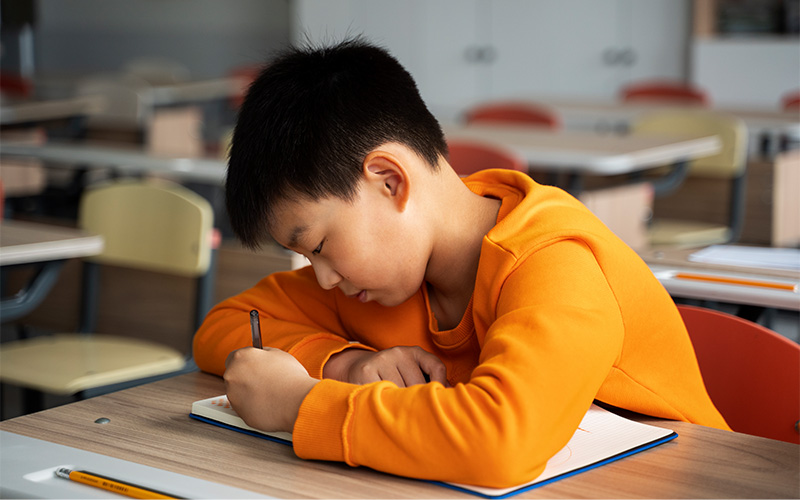
Even strong students benefit from a quick planning routine before they start writing. Taking just 3–5 minutes to outline the story often leads to clearer writing and more coherent compositions.
Outline curation helps to:
- Decide the main conflict
- Arrange events in order
- Ensure the story stays on theme

 Choice Hua Sheng