

Introduction
In spoken Mandarin, 的、得、地 (de) all sound the same. This similarity often gives learners the impression that these three characters are interchangeable. In writing, however, each particle plays a distinct grammatical role and cannot be used freely without changing the meaning or structure of a sentence.
Although these three forms share identical pronunciation, they behave very differently once placed into a written sentence. One links descriptions to nouns, another explains how an action is carried out, while the third connects verbs to outcomes or degrees. Confusing them is not a stylistic issue but a grammatical one.
Mastering “de” in Chinese is essential for clear, accurate expression. It directly affects sentence clarity, coherence, and meaning, particularly in formal writing contexts such as school compositions and examinations. Students who understand how these particles work can construct sentences that read naturally and logically.
A clear understanding of how each particle functions and when to use it underpins strong Chinese grammar. Accurate application of “de” in Chinese is essential for constructing well-formed sentences. This knowledge supports accurate Chinese sentence structure and helps students minimise common grammar mistakes.
Key Takeaways:
1. Why is “de in Chinese” so difficult for students to master?
Because 的、得、地 sound identical in spoken Mandarin but perform different grammatical roles in writing. Without understanding the sentence function of “de” in Chinese, students rely on guessing, which leads to frequent errors in composition and editing tasks.
2. Which “de” particle in Chinese appears most often in primary school writing?
的 appears most frequently because it modifies nouns in descriptions. However, accurate use of 得 and 地 is what differentiates stronger writers and prevents common grammar mistakes.
3. How does incorrect “de” usage affect PSLE scores?
Incorrect use of 的、得、地 weakens sentence clarity. It often results in lost marks in editing sections and language accuracy bands, even when content ideas are strong.
4. Can students rely on spoken Mandarin to decide which “de” to use?
No. Spoken Mandarin provides no distinction between 的、得、地. Correct usage depends entirely on understanding Chinese sentence structure and the relationship between verbs, adjectives, and nouns.
5. What is the most effective way to improve accuracy with “de” in Chinese?
Consistent exposure through reading, guided sentence analysis, and targeted writing practice helps students internalise Chinese language usage rules and reduce repeated errors.
How Each “De” in Chinese Functions
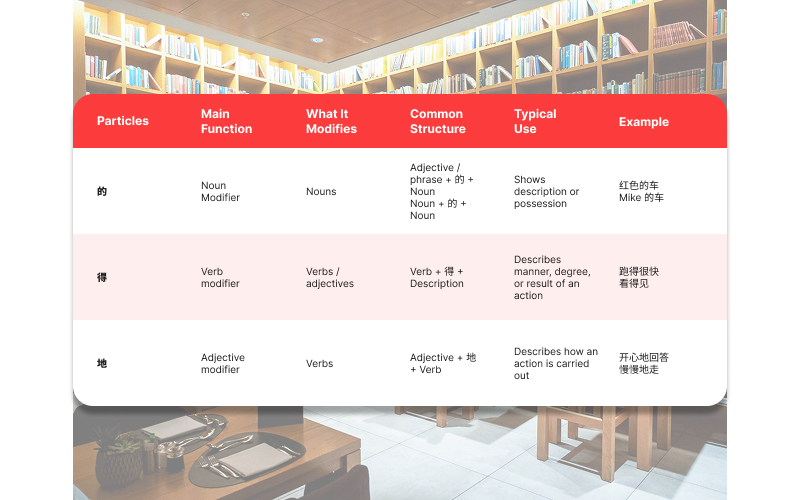
Although 的、得、地 sound identical, each one performs a unique grammatical function. Understanding these roles reduces reliance on trial and error.
1. 的 (de) — The Noun Modifier
的 is used to link descriptions to nouns. It can indicate possession, identify attributes, or connect a descriptive phrase to a noun. In most cases, it answers the question “which one” or “what kind”.
Common Structures:
Possessive structure:
Noun + 的 + Noun
Attributive structure:
Adjective or descriptive phrase + 的 + Noun
Examples:
Mike 的车 (Mike de chē)
This shows ownership. The car belongs to Mike.
红色的车 (hóng sè de chē)
Here, 红色 describes the noun 车.
喜欢吃蛋糕的男生 (xǐ huān chī dàngāo de nán shēng)
The phrase 喜欢吃蛋糕 describes the noun 男生.
不听话的孩子 (bù tīng huà de hái zi)
The descriptive phrase modifies 孩子.
Key Notes:
When using “de” in Chinese, 的 connects descriptions or possession to a noun. However, it can sometimes be omitted with very short, commonly paired adjectives. For example, 大人 is often preferred over 大的人 in natural speech. Despite this, including 的 remains grammatically correct for learners.
2. 得 (de) — The Verb Modifier
得 describes how an action is performed or the degree to which it occurs. It connects a verb to its result, evaluation, or outcome. It is also used in potential complements to express ability or possibility. When 得 is not used as a particle, it can be read as dé, meaning “to obtain”, or děi, meaning “must”. Pronunciation depends on meaning and context.
Common Structures:
Verb + 得 + Description or outcome
Verb + 得到 / 得见 / 得懂 to show success or ability
Adjective + 得 + Comparative expression for comparisons
Examples:
学得很努力 (xué de hěn nǔ lì)
The phrase 很努力 explains how the studying is done.
唱得不好听 (chàng de bù hǎo tīng)
不好听 evaluates the quality of the action 唱.
看得见 (kàn de jiàn)
This expresses the ability to see.
比旧金山热得多 (bǐ Jiù Jīn Shān rè de duō)
得 connects the adjective 热 to the comparative outcome.
In negative potential forms, 得 is not used. Instead, 不 is placed directly into the verb compound.
Correct Examples:
看不见
听不懂
Using 得 in these negative structures is grammatically incorrect.

3. 地 (de) — The Adjective Modifier
When using “de” in Chinese, 地 turns adjectives or descriptive phrases into adverbs. It explains how an action is carried out and functions similarly to “-ly” in English.
Common Structure:
Adjective + 地 + Verb
Examples:
慢慢地走过来 (màn màn de zǒu guò lái)
慢慢 describes the manner of walking.
开心地回答 (kāi xīn de huí dá)
开心 modifies the verb 回答.
飞快地跑过来 (fēi kuài de pǎo guò lái)
快快 emphasises the speed of the action.
Additional Insight:
- Adjectives are often reduplicated before 地 to add emphasis or vividness.
- When 地 is not used as a particle, it is pronounced dì, as in 土地, meaning land or ground.
Using “De” Particles Correctly in Primary Chinese Composition
What are Some Common Exam Questions Involving 的、得、地?
Understanding grammar rules alone is insufficient. Accurate application of “de” in Chinese depends on the ability to use these particles correctly within complete sentences and varied writing contexts. Effective primary school Chinese tuition supports this process by helping students practise applying grammar rules consistently through structured writing tasks.
1. Editing Section Traps
Many PSLE editing items involve incorrect swapping of 的、得、地, a common issue when applying “de” in Chinese in written sentences. These errors are subtle and often appear in sentences that already look fluent.
A common mistake is using 的 instead of 得 after verbs.
他跑的很快。(tā pǎo de hěn kuài)
This is incorrect.
他跑得很快。(tā pǎo de hěn kuài)
This is correct.
跑 (run) is a verb, and 很快 (very fast) describes how the action is performed, so 得 must be used.
Another frequent error involves using 地 before nouns.
她穿着漂亮地裙子。(tā chuān zhe piào liang de qún zi)
This is incorrect.
她穿着漂亮的裙子。(tā chuān zhe piào liang de qún zi)
漂亮 (beautiful) describes the noun 裙子 (skirt), so 的 is required.
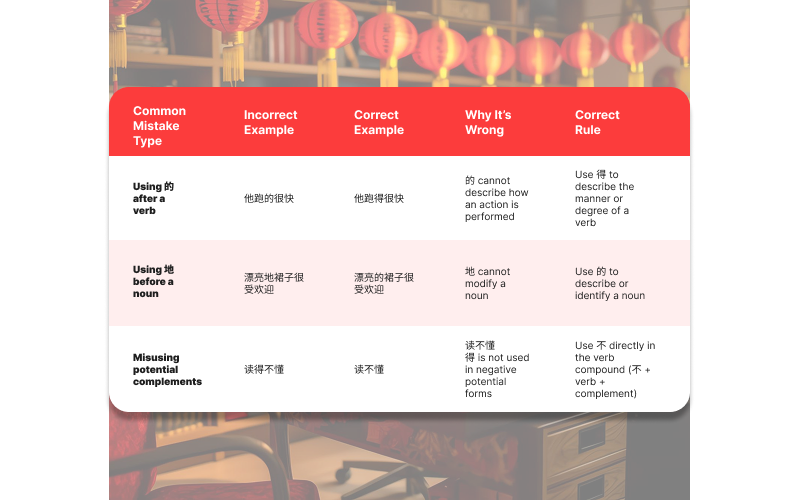
Understanding verb and adjective modifiers helps students avoid these errors systematically.
2. Composition Use
Correct use of “de” in Chinese improves composition flow and logical clarity. When actions, descriptions, and outcomes are linked accurately, writing feels structured and cohesive. Markers reward compositions where sentence relationships are clear and grammatically sound. Incorrect usage often leads to weaker coherence and unnecessary loss of language marks, even when ideas are strong.
In the PSLE Chinese grammar assessment, accuracy in particle usage plays a part in how language control is evaluated. Students are assessed on whether they can apply grammatical rules consistently within complete sentences, particularly when linking descriptions, actions, and outcomes in their writing.
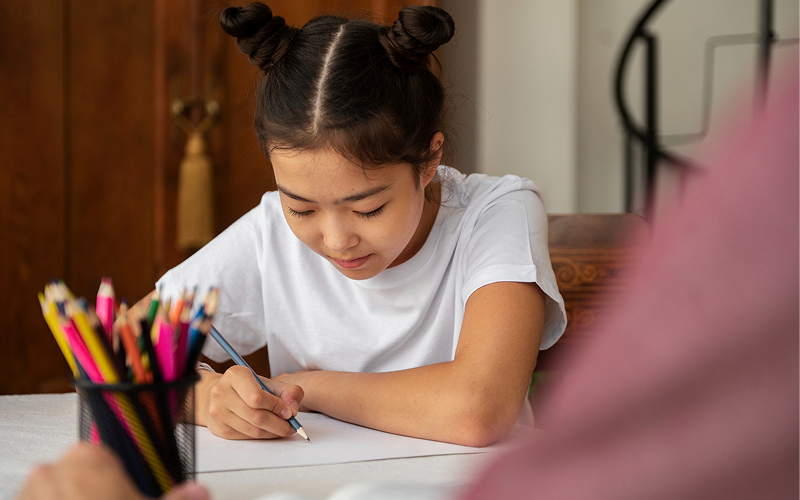
Regular, guided practice in a Chinese composition writing class can strengthen this aspect of writing. Through structured lessons and insightful learning resources, students learn how to reinforce correct sentence structure and grammatical precision over time.
What are Some Practical Examples from Everyday Chinese?
Seeing grammar in real contexts allows students to internalise rules more effectively than memorisation. When learners encounter grammatical structures in everyday Chinese, such as in daily conversations, reading passages, classroom discussions, or simple written exchanges, they begin to understand how these rules function naturally within complete sentences.
Examples of “de” in Chinese:
她认真地写作业。(tā rèn zhēn de xiě zuò yè — She does her homework carefully.)
认真 describes how the action is done.
我跑得很快。(wǒ pǎo de hěn kuài — I run very fast.)
很快 explains the degree of the action.
红色的书包在桌子上。(hóng sè de shū bāo zài zhuō zi shàng —The red schoolbag is on the table.)
红色 modifies the noun 书包.
Exposure through reading, listening, and guided writing helps reinforce sentence structure naturally. In the long run, learners begin to recognise which particle “sounds right” because they understand its function. This gradual internalisation supports long-term accuracy in both spoken and written Chinese.
Why Students Learn Better With Choice Hua Sheng
Learning grammar effectively requires more than worksheets. At Choice Hua Sheng, our Chinese tuition centre in Singapore teaches “de” in Chinese alongside other key grammar concepts through a structured approach.
Students benefit from our experienced teachers who bring years of classroom expertise and a patient, structured approach to instruction. Through consistent guidance and engaging lesson design, students build confidence while developing essential language skills. These include accurate use of Chinese grammar particles such as 的、得、地. As such, students show steady improvement in grammar accuracy and overall language control across both written and spoken Chinese.
Frequently Asked Questions
1. Does “的” always mean possession?
No. While 的 can show possession, it is mainly used to describe or identify nouns.
For example, 漂亮的花 describes the flower’s appearance instead of ownership.
2. Which “de” should be used more often in composition writing?
的 appears most frequently because compositions involve many descriptions of people, objects, and settings. However, correct use of 得 and 地 demonstrates a stronger command of Chinese grammar and improves overall language marks.
3. Is “地” disappearing from modern writing?
In informal messaging, 地 is often replaced with 的 for convenience. However, formal writing and examinations still require correct usage. Using 地 accurately remains essential for exam-standard writing.
4. Why do students confuse 的、得、地 so easily?
All three “de” particles in Chinese share the same pronunciation, and many students rely on sound rather than sentence function. Without a clear understanding of grammatical roles, it becomes difficult to differentiate de particles, especially when verbs, adjectives, and nouns appear close together in a sentence. This often results in confusion even when students are familiar with the basic rules.
5. How can primary students practise using “de” more accurately?
Consistent exposure through reading, sentence transformation exercises, and composition practice helps reinforce correct usage. Practice that is aligned with PSLE Chinese composition requirements guides students in applying particles accurately when linking descriptions, actions, and outcomes. Targeted feedback plays an important role in reinforcing correct usage and preventing repeated errors.
Conclusion
Learning “de” in Chinese is not about memorising isolated rules, but about understanding how meaning is constructed within a sentence. Accurate use of 的、得、地 allows students to express ideas clearly and meet the language standards expected in formal writing. When these particles are applied correctly, writing becomes more precise and logically connected.
Regular practice through reading, sentence drills, and exposure to well-structured writing can enhance these skills over time. With proper guidance, students can overcome confusion and apply “de” in Chinese confidently across different writing contexts.
If you are seeking structured support for your child through Chinese language tuition, a dedicated learning programme can offer targeted instruction aligned with school requirements. Lessons often feature a systematic learning approach that helps students strengthen core language skills, clarify common areas of confusion, and practise applying grammar rules accurately in context.
At Choice Hua Sheng, we guide students through a structured learning process that builds accuracy, confidence, and long-term language control. Through our PSLE Chinese tuition and other classes, we help students develop a strong foundation in Chinese while encouraging independent thinking and sustained progress. Our aim is to inspire a genuine interest in learning, so that students not only master the language but also gain the skills needed to continue learning with confidence over time.
Contact us and learn how we can enrich your child’s learning experience.




 Choice Hua Sheng