

Introduction
Chinese verbs are words that describe actions or states, commonly referred to as 动作词 (dòng zuò cí – action words) and 状态词 (zhuàng tài cí – state or condition words). As the backbone of how sentences are built, they are the key foundation for reading, writing, and comprehension in primary school Chinese.
When children understand how verbs work, they are better able to express ideas clearly and make sense of what they read. Sentence meaning in Chinese often depends more on verb choice and placement than on word endings or tense changes, which makes early understanding essential.
Many parents share a similar concern: “My child knows many Chinese words, but still struggles to form correct sentences.” In many cases, the missing link is not vocabulary, but how verbs are understood and applied. Children may recognise individual words yet remain unsure how to combine them meaningfully.
This guide breaks down what Chinese verbs are, how they work, and why mastering them early helps children build stronger language foundations. It also explains where common learning gaps occur and how structured guidance can support steady progress in primary school Chinese.
Key Takeaways:
1. Why are Chinese verbs essential for sentence clarity in primary school?
Chinese verbs carry the core meaning of a sentence. When children understand how to use them correctly, sentences become clearer and comprehension improves across reading and writing tasks.
2. How does weak verb understanding affect exam performance?
Inaccurate verb usage can lead to misinterpretation of comprehension passages and vague composition writing, which directly affects content and language marks.
3. Is memorising verb lists enough for strong Chinese foundations?
Memorisation alone is rarely sufficient. Children need to understand how verbs function in context to apply them accurately in sentences and longer writing.
4. When should parents start paying attention to verb usage?
Foundational verb understanding begins in lower primary, but gaps often surface in Primary 3 and above when sentence complexity increases.
Overview of Chinese Verbs
What Is a Chinese Verb?
Chinese verbs, known as 动词 (dòng cí), are words that describe actions, thoughts, feelings, or states. They are essential building blocks of sentences and play a key role in helping children express ideas clearly in Chinese.
A common misconception is that verbs only describe physical actions such as running, eating, or moving. While these are important, Chinese verbs also express mental processes, emotions, relationships, and states of being. They can be grouped into a few broad categories that reflect how meaning is conveyed in sentences.
In simple terms, verbs tell us:
- What someone is doing
- What someone is thinking or feeling
- What state something is in
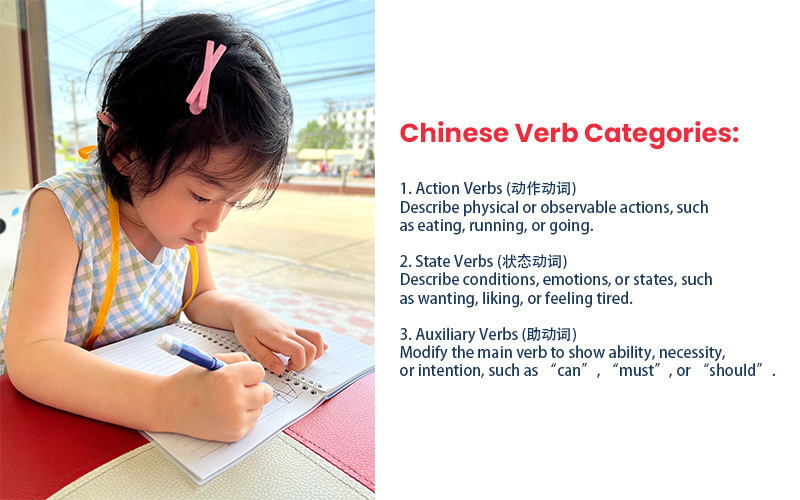 1. Action Verbs (动作动词 – dòng zuò dòng cí)
These describe physical or observable actions, such as eating, running, or going.
2. State Verbs (状态动词 – zhuàng tài dòng cí)
These describe conditions, emotions, or states, such as wanting, liking, or feeling tired.
3. Auxiliary Verbs (助动词 – zhù dòng cí)
These modify the main verb to show ability, necessity, or intention, such as “can”, “must”, or “should”.
Understanding these distinctions helps children move beyond rote learning. Instead of memorising words in isolation, they begin to recognise how verb choice affects sentence meaning.

What are Some Common Chinese Verbs Primary Students Learn?
At the primary level, children are commonly introduced to everyday verbs that appear frequently in textbooks, comprehension passages, and oral communication. Examples include:
- 看 (kàn) – to look or watch
- 走 (zǒu) – to walk
- 想 (xiǎng) – to think or want
- 觉得 (jué de) – to feel or think in terms of opinion
These verbs go beyond physical actions. Some describe internal processes such as thinking or feeling. In primary school Chinese, many key ideas in passages and compositions are conveyed through these less obvious verb types. This is why Chinese verb usage for primary students is closely linked to comprehension and composition rather than being a narrow grammar topic. A child may recognise individual words, yet still struggle to grasp the message of a sentence if the verb’s role is unclear.
When children understand how these verbs operate within different sentence structures, they become more confident in interpreting intent, emotion, and sequence. This clarity allows them to construct sentences that communicate ideas more precisely, supporting stronger comprehension responses and more coherent written expression.
Why This Matters for Primary Students
Verb understanding is not an abstract concept for young learners. It directly affects how they perform in everyday classroom tasks. From answering comprehension questions to constructing simple written responses, accurate verb usage shapes whether a child’s ideas are understood as intended.
When children do not fully understand how verbs work, they may:
- Write sentences that sound awkward or incomplete
- Misinterpret key actions or emotions in comprehension passages
- Struggle to express ideas clearly in compositions
Over time, these difficulties compound. As sentence structures become more complex in upper primary, gaps in Chinese sentence structure skills become more noticeable and harder to correct without targeted support. This often shows up in longer comprehension passages where students misinterpret actions or intentions, and in compositions where ideas are present but sentences lack clarity or logical flow.
 .
.
Building a strong foundation early helps children cope more confidently with increasing language demands. When key concepts such as verb usage are addressed at the primary level, children are less likely to feel overwhelmed as reading and writing tasks become more demanding. One effective way to support this foundation is through Primary School Chinese tuition. Structured guidance reinforces how verbs function within sentences and provides consistent practice aligned with school expectations.
Why Chinese Verbs Confuse Children (Compared to English)
Many primary school children in Singapore learn Chinese alongside English. This means they naturally attempt to apply familiar English grammar rules when forming Chinese sentences. As such, it creates confusion, especially when the same expectations about tense and verb changes do not apply. One major source of misunderstanding is that Chinese verbs do not change form, even when the timing of an action shifts.
In English, verbs change depending on tense:
- He works
- He worked
- He will work
In Chinese, the verb remains the same. Meaning is conveyed through sentence structure and context rather than verb conjugation. Instead, sentences rely on:
- Time words such as 今天 (jīn tiān – today)
- Additional markers, such as 了 (le,) to indicate completion
Without explicit explanation, children often attempt to apply English grammar rules to Chinese. This leads to errors that are difficult for them to self-correct, especially when feedback focuses only on whether an answer is right or wrong.
What is the Common Learning Gap in Primary Chinese Verbs?
A common learning gap in primary Chinese verbs lies in the disconnect between recognising a word and knowing how to use it meaningfully. Many students can memorise verb lists and identify correct answers in isolated exercises, yet struggle when asked to apply those same verbs in complete sentences. Without understanding how verbs function within sentence structures, knowledge remains fragmented, making it difficult for children to express ideas clearly in writing or interpret meaning accurately in context.
This gap appears in several ways:
- Misunderstanding actions or emotions in comprehension passages
- Awkward or unclear sentence construction
- Repetitive or disjointed compositions
- Difficulty selecting the most precise verb for an answer
As expectations increase, children may feel frustrated despite memorising more vocabulary. Confidence can decline when effort does not translate into better results.
Why Chinese Verb Usage Affects Comprehension and Composition Scores
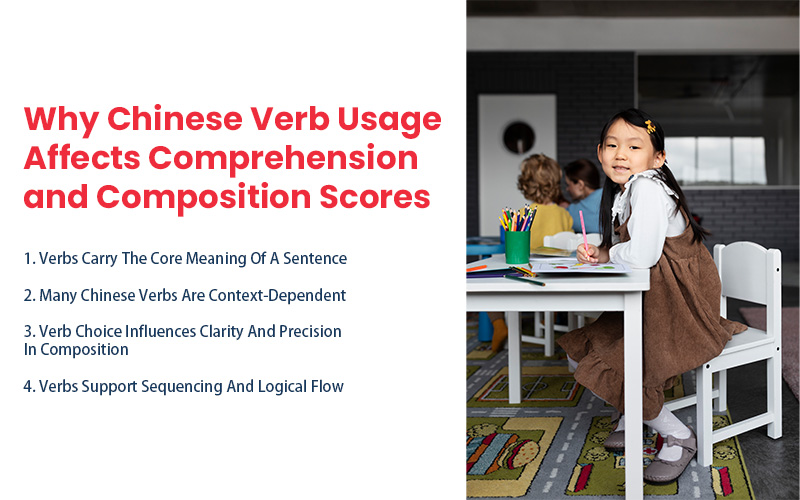
1. Verbs Carry The Core Meaning Of A Sentence
In Chinese, verbs often convey the main action, state, or intention. Misunderstanding a verb can change the meaning of an entire sentence, even if all other words are familiar.
2. Many Chinese Verbs Are Context-Dependent
A single verb can take on different meanings depending on context. This affects how children interpret characters’ intentions or emotions in comprehension passages.
3. Verb Choice Influences Clarity And Precision In Composition
Using vague or incorrect verbs makes writing unclear. Strong verb usage supports more coherent and intentional compositions, improving both content and language scores.
4. Verbs Support Sequencing And Logical Flow
Narrative writing relies heavily on verbs to show progression and cause. Weak verb usage can disrupt flow, even when ideas are present.

Parent Involvement and Structured Guidance: Learning Chinese Verbs Effectively
What Problems Parents Commonly Face at Home
Many parents want to support their child’s Chinese learning but encounter challenges, especially in households where Mandarin is not used daily. Without strong confidence in the language, parents may struggle to explain grammar rules or correct verb usage clearly. They may also feel uncertain about how school expectations change under the MOE Chinese syllabus alignment, which makes home support feel limited despite good intentions.
Common questions include why a child’s sentence sounds incorrect even though all the words appear right, and how parents can help if they are not strong in Chinese themselves. These concerns highlight gaps in understanding, not effort. A strong Chinese grammar foundation for children often requires clear, direct explanations that go beyond supervising homework alone.
How Children Should Learn Chinese Verbs the Right Way
While remembering word meanings has its place, real mastery develops when children first understand how verbs function within sentences and contexts. Without this understanding, vocabulary knowledge remains fragmented and difficult to apply. Children learn verbs most effectively when understanding precedes memorisation, allowing them to recognise not just what a verb means, but why it is used in a particular way and how it shapes sentence meaning.
Effective approaches include:
- Learning verbs within meaningful sentences rather than isolated lists
- Observing how verbs function in different reading contexts
- Applying verbs through speaking, comprehension, and writing
This analytical approach helps children understand why a verb is used in a particular situation. In the long run, it strengthens Chinese comprehension and writing skills by allowing knowledge to transfer across tasks.
How Structured Guidance Helps Close the Learning Gap
Many children struggle with Chinese verbs not because they lack ability, but because their learning is fragmented. Worksheets, spelling lists, and test corrections often focus on outcomes rather than understanding. Structured guidance provides the consistency that many children need by organising learning into clear, progressive steps. Instead of isolated practice, children receive repeated exposure to how verbs function across reading, writing, and comprehension tasks, which helps close gaps that informal or ad hoc learning often leaves behind.
Effective programmes typically include:
- A clear progression from simple to complex sentence structures
- Regular feedback to clarify mistakes and reinforce learning
- Integration of verb usage across comprehension and composition
One limitation to note is that progress is not always immediate. Children who have relied on memorisation may need time to adjust to analytical learning. However, with patient instruction, understanding becomes more stable and transferable.
This is where structured Chinese language tuition can be particularly helpful, especially when aligned closely with school expectations. For instance, during PSLE Chinese tuition, focused guidance helps students apply verb usage accurately under exam conditions, where clarity, precision, and contextual understanding are critical for scoring well.
How Choice Hua Sheng Supports Verb Learning Effectively
At Choice Hua Sheng Education Centre, a trusted Chinese tuition centre in Singapore, verb learning is integrated into the broader goal of building strong, lasting language foundations.
Our programmes:
- Follow an MOE-aligned curriculum to support school learning
- Emphasise understanding and application over rote memorisation
- Provide structured progression across primary and secondary levels
By strengthening verb usage early, students develop more confident Chinese sentence structure skills and gain clearer control over how ideas are expressed. This prepares them more effectively for upper primary demands and PSLE assessments. Parents seeking primary Chinese tuition may find that this structured, foundation-led approach helps children regain confidence, improve clarity, and engage more positively with the language.

Frequently Asked Questions
1. Why does my child know many Chinese words but still struggle with sentences?
Many children memorise vocabulary without understanding how words function together. Weak verb understanding often causes sentences to sound awkward, even when the vocabulary is correct.
2. When should children start learning proper Chinese verb usage?
Basic verb usage begins in lower primary, but proper understanding becomes increasingly important from Primary 3 onwards as comprehension and composition tasks become more demanding.
3. How can parents support Chinese verb learning if we do not speak the language at home?
Parents can focus on encouraging understanding. Asking children to explain sentence meaning and seeking structured support through Chinese tuition in Singapore can help bridge gaps effectively.
Conclusion
Chinese verbs are not a minor grammar detail. They form a core foundation that supports reading, comprehension, and writing throughout primary school. When children understand how verbs function, they gain greater clarity in expression and confidence in handling increasingly complex language tasks. Parents can support this process by focusing on understanding and application. With the right guidance, children can close learning gaps early and develop a more positive relationship with Chinese as a subject.
For families looking for structured support through Chinese language tuition, enrolling in Choice Hua Sheng’s programmes can provide the clarity, progression, and reassurance children need to build strong and lasting Chinese language foundations.
Get in touch to check on our class availability.





 Choice Hua Sheng